The Subsea Cable Cold War: Sabotage in the Deep



Written by Mauricio Preuss (CEO & Co-Founder) & Valentina Bravo (Managing Editor)
Reviewed by Aleksander Hougen (Chief Editor)
Last Updated:
Are you bundled up under a blanket with a hot cup of coffee, ready to hear a tale about treachery in the deep seas? I’ve got a great one for you.
Once upon a time, back on November 17, 2024, a Chinese cargo ship called the Yi Peng 3 was traveling through the Baltic Sea when something unusual happened [1].
The ship’s anchor dropped to the seafloor and dragged behind it for approximately 100 nautical miles, carving a trench across two critical internet cables [1][2]. One cable connected Finland to Germany. The other linked Sweden to Lithuania. Both were severed completely.
Danish warships intercepted the vessel as it attempted to leave the Baltic [1]. Apparently, when you cut the communications infrastructure of multiple NATO countries, people get curious about your itinerary.
For an entire month, the Yi Peng 3 sat anchored in Danish waters while diplomats negotiated who could board it and under what terms. When investigators finally examined the ship, they found its anchor visibly damaged [1]. Swedish and Finnish authorities launched criminal investigations.
The conclusion? Swedish investigators found the evidence “did not establish” that the damage was deliberate [1]. China called it an unfortunate maritime accident. After the standoff ended, the ship departed and resumed normal operations.
“But Mauricio,” you may ask, “why should I give a damn about this tall tale?” Good question.
Turns out, almost everything you do online crosses the ocean through physical cables lying on the seafloor, and most people have no idea those cables even exist [3]. When they break, entire regions can go dark for months. And, as it turns out, not everyone’s convinced that these are mere accidents.
However, before we dive deeper into the sabotage portion of this tale, let’s go over what this mysterious underwater infrastructure is all about.
The Invisible Backbone of Everything You Do Online
When you send an email to another continent, access cloud services hosted overseas, or stream a show from international servers, that data crosses the ocean through physical cables lying on the seafloor. Nearly 99% of intercontinental internet traffic travels this way [3].
And here’s the part that kinda took me by surprise: even domestic services often route through this same international infrastructure. Approximately 97% to 98% of all global internet traffic depends on submarine cable systems at some point [4].
Right now, there are about 597 subsea cables operating globally, carrying everything: your video calls, financial transactions, military communications, cloud backups, and the Google Doc where I’m typing this right now [5]. These cables are fiber-optic lines about the diameter of a garden hose, stretching thousands of miles across the ocean floor.
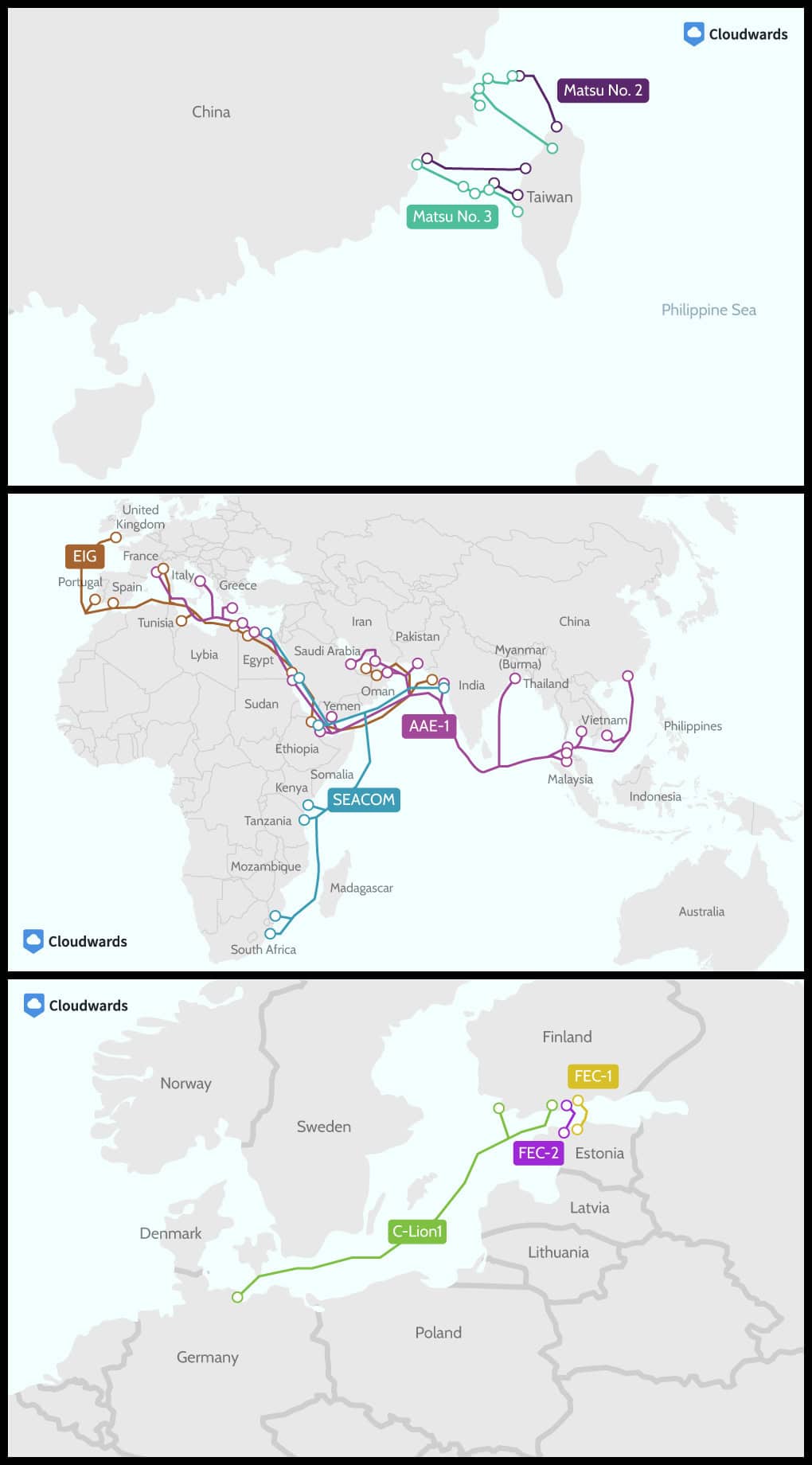
Most of them run through shallow water, less than 200 meters deep, where a ship’s anchor can easily reach them [6]. They’re also concentrated in strategic chokepoints rather than spread evenly across the seafloor. The Red Sea corridor carries massive amounts of traffic between Europe and Asia. The Baltic Sea connects NATO allies. The Taiwan Strait links Taiwan to the outside world. Cable landing stations, where these undersea lines connect to terrestrial networks, often host multiple cables in the same location because it’s logistically easier and cheaper [7].
🔒This is where the free preview ends.
Join thousands of professionals who get the complete story
Our Deep Dive subscribers rely on these investigations to stay ahead of emerging threats and make informed decisions about technology, security, and privacy.
✅ Complete access to this investigation
✅ All future Deep Dive reports
✅ Searchable archive of past investigations
✅ No ads, no sponsored content
✅ Cancel anytime