Cloudflare Outages: The Dangers of a Centralized Internet



Written by Mauricio Preuss (CEO & Co-Founder) & Valentina Bravo (Managing Editor)
Reviewed by Aleksander Hougen (Chief Editor)
Last Updated:

I tried to load Substack on the morning of November 18, 2025. A newsletter had just hit my inbox and I wanted to read it before starting work. You know, my usual morning procrastination routine.
Instead, I got a 500 error.
No big deal, right? Services go down. I refreshed.
Still down.
I opened X to complain about Substack being down (because what else do you do when a service breaks?). X was down too.
Then Discord wouldn’t load. Shopify threw an error. My Forex trading dashboard was frozen. I checked Downdetector, which was also down, and it hit me.
This wasn’t a Substack problem. This wasn’t even a “multiple services” problem.
One-fifth of the entire internet had just stopped working.
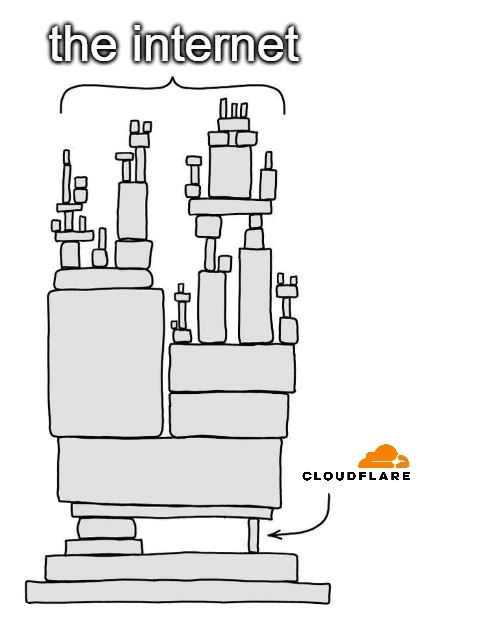
For the next three hours, millions of us sat there refreshing pages that wouldn’t load, watching trading platforms hemorrhage $1.6 billion in volume, and slowly realizing something uncomfortable: the internet isn’t actually distributed at all.
It all runs through one company you’ve probably never thought about.
That company is Cloudflare. And when it breaks (which it did twice in three weeks), the “world wide web” becomes a very small, very broken place.
There’s this popular story about how the internet was designed to survive nuclear war. A decentralized network where destroying one node wouldn’t bring the whole system down. The real history is less dramatic: the early internet (a military research project called ARPANET) was built so university researchers could share expensive mainframe computers without flying across the country [1].
But that resilience story became gospel anyway. Cryptographers cite it and privacy advocates invoke it. Blockchain enthusiasts built entire manifestos around the idea of an inherently resilient, distributed network.
Except we’ve spent the last two decades doing the exact opposite. We centralized everything and put all our eggs in one basket that’s invisible to most people.
So today I’m going to walk you through how Cloudflare’s outages in November and December 2025 were inevitable, and what it means that the internet’s immune system has become its biggest vulnerability.
What the Hell Is Cloudflare Anyway?
Most people have no idea what sits between them and the websites they visit. You type in a web address, press enter, and you think you’re connecting directly to that website’s server. But you’re not. Your request first goes to Cloudflare, which acts as a middleman, checking your traffic, blocking attacks, and then forwarding you to the actual site. All of this happens in milliseconds, completely invisibly.
🔒This is where the free preview ends.
Join thousands of professionals who get the complete story
Our Deep Dive subscribers rely on these investigations to stay ahead of emerging threats and make informed decisions about technology, security, and privacy.
✅ Complete access to this investigation
✅ All future Deep Dive reports
✅ Searchable archive of past investigations
✅ No ads, no sponsored content
✅ Cancel anytime